
International Baseball Postage Stamps
While baseball is often called America’s pastime, several countries issued postage stamps featuring the sport before the United States did. The Philippines released the first known baseball postage stamp in 1934 to commemorate the Far Eastern Championship Games. Colombia, Nicaragua, and Panama soon followed with their own baseball-related issues tied to regional “Games” events. The United States did not depict baseball on a postage stamp until 1939, when it marked the Centennial of Baseball.
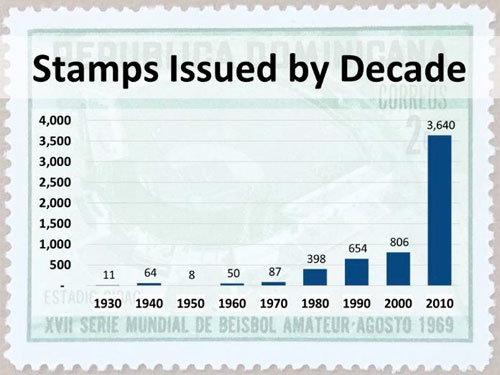
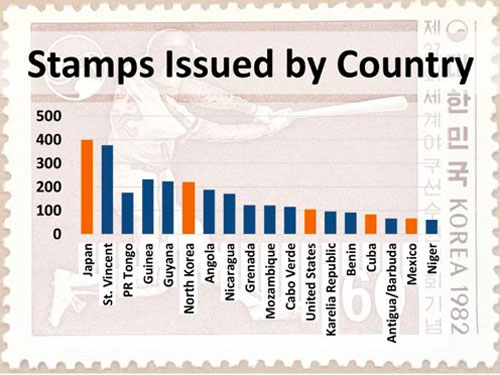
Beginning in the 1960s, baseball imagery expanded rapidly on international stamps. Today, more than 7,000 baseball-related stamps have been issued by approximately 170 countries through 2025. The charts below are based on data from The History of Baseball as Depicted in Postage Stamps by David Schulz.
Following are the first 29 international postage stamps featuring baseball – all prior to 1960.
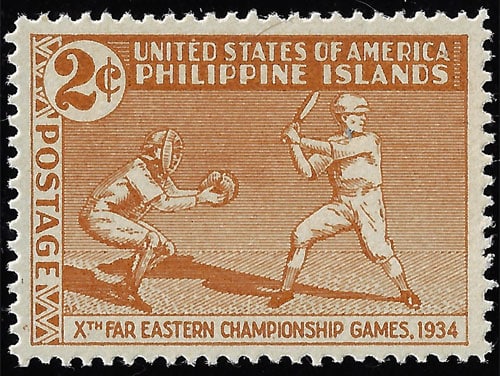
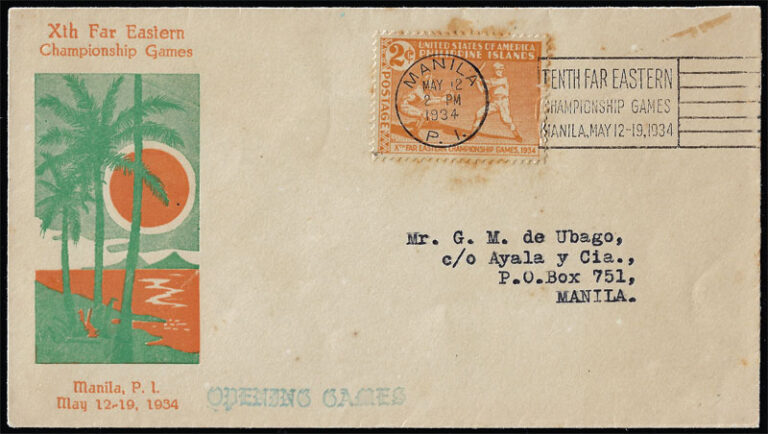
1934 Philippine Islands – 10th Far Eastern Championship Games
Issued on April 14, 1934, this stamp is widely regarded as the first postage stamp in the world to feature baseball. It was released to commemorate the 10th Far Eastern Championship Games, a major regional multi-sport event in East and Southeast Asia.
The Games were held in Manila from May 16–20, 1934, and included competitors from China, Japan, the Dutch East Indies, and the Philippines. Eight sports were contested, with baseball, basketball, and tennis selected for depiction on postage stamps. The Philippines won the baseball competition, earning the gold medal over Japan.
There is occasional debate over whether the Philippines or the United States should be credited with issuing the first baseball stamp. At the time, the Philippines was under U.S. sovereignty following the Treaty of Paris, in which Spain ceded the colony to the United States after the Spanish-American War of 1898. The Philippines did not gain full independence until 1946. Despite this, the stamps were issued locally and identify the Philippines as the issuing authority.
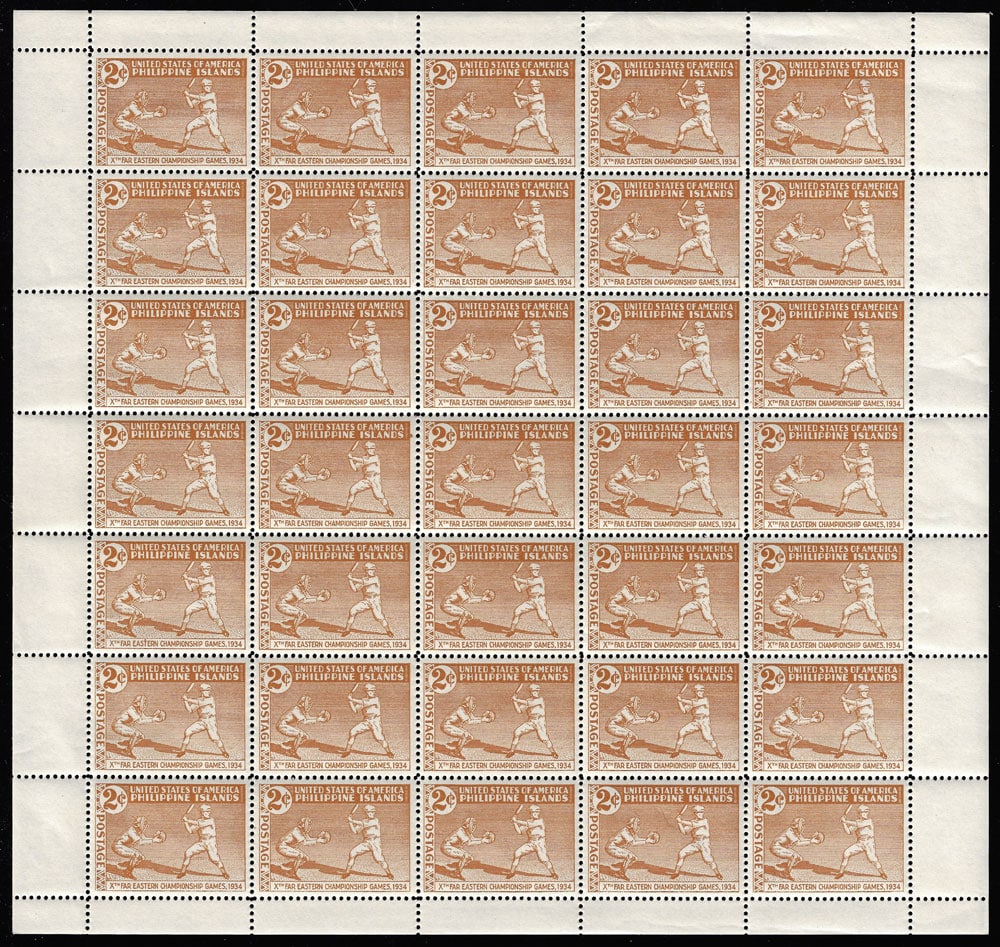
All three stamps in the set were designed by Fernando Amorsolo and printed by the Philippine Bureau of Printing in sheets of 35, with a total production of 971,414 stamps.
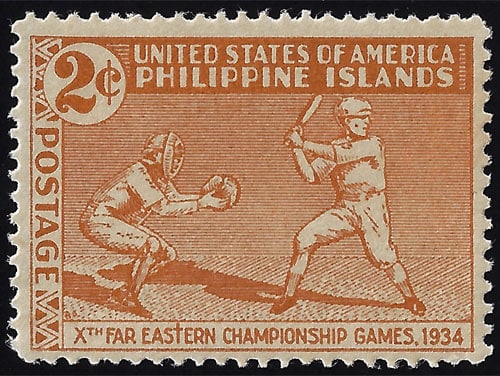
A rare and unlisted variety of this stamp, known among collectors as the “Malformed T,” features a distinctive printing flaw: a small circular mark above the crossbar of the letter “T” in “Eastern.” This variation is scarce, occurring only once per sheet of 35—specifically on the third stamp from the bottom in the leftmost column—making it a challenging find for collectors.
The sheet below contains 35 stamps and is extremely rare. It is essentially the Honus Wagner of baseball stamps, the first ever produced, and a full sheet being nearly impossible to find.
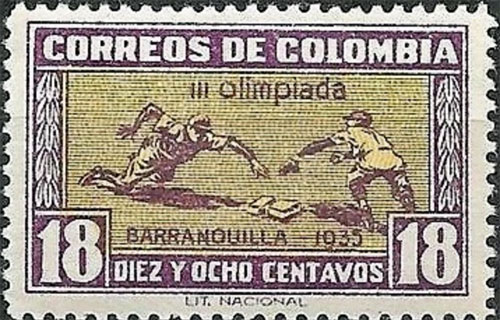
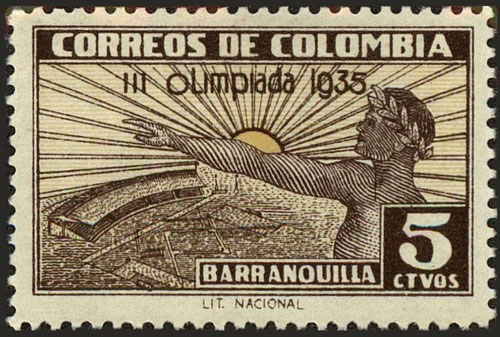
1935 Colombia Olympics
These stamps were issued by Colombia in 1935 to commemorate the III Olimpiada Nacional, a national multi-sport competition held in Barranquilla. Despite the Olympic-style name and imagery, this was not an International Olympic Games event, but rather a domestic athletic festival modeled on the Olympic tradition.
The complete set consists of 16 stamps depicting a mix of athletic competitions and symbolic or scenic subjects. One stamp specifically features baseball, showing a baserunner sliding into a base as a fielder attempts a tag. Another presents a classical Olympic greeting figure with the Barranquilla stadium visible in the background. Additional sports in the set include soccer, swimming, tennis, discus throwing, hurdles, and running, while non-sport subjects include national symbols, architecture, and local scenery, reflecting both athletic and civic pride tied to the 1935 Games.
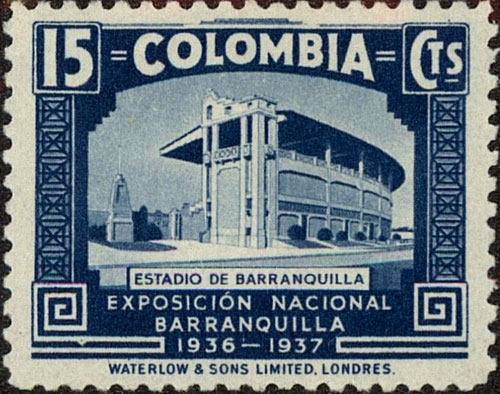
1937 Colombia – Barranquilla Stadium
Issued in April 1937, this stamp was part of a Colombian commemorative set marking the National Industrial Exposition held in Barranquilla, capital of the Atlántico Department. The series highlighted notable modern buildings associated with the exposition, including the Estadio de Barranquilla, underscoring the city’s growing national importance during the 1930s.
The stadium depicted was conceived in 1932 and completed in 1934 as Estadio Municipal de Barranquilla, later renamed Estadio Romelio Martínez. Built for the 1934 National Games of Colombia, it had an initial capacity of approximately 10,000 spectators and was designed in the Art Deco style. During its early years, the venue hosted multiple sports, including baseball, which was already well established in Barranquilla and the Caribbean region, making the stadium an early site for organized baseball in Colombia.
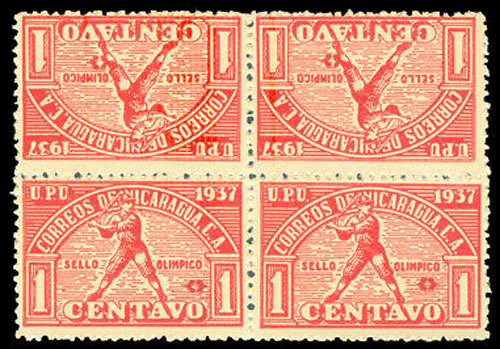
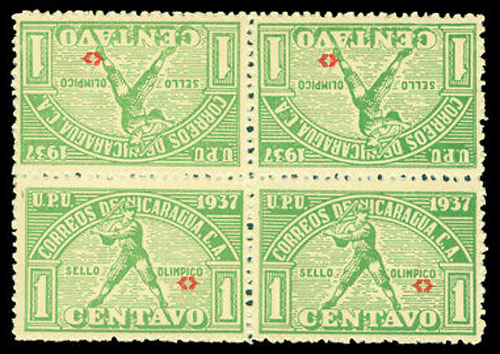
1937 Nicaragua – Central American Caribbean Games
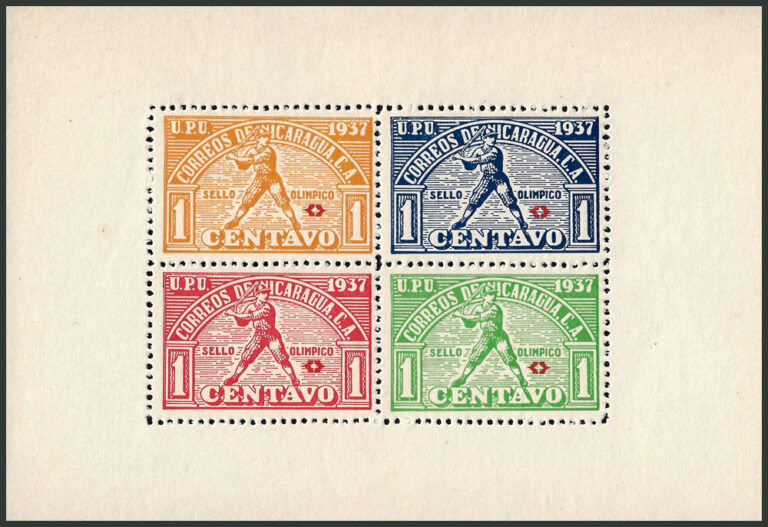
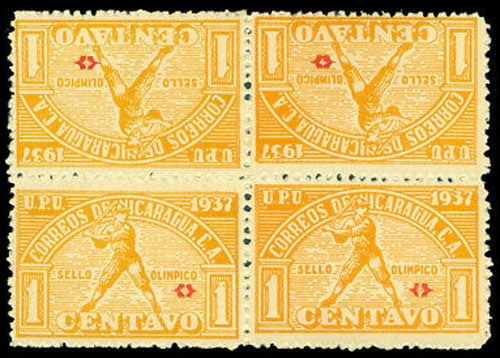
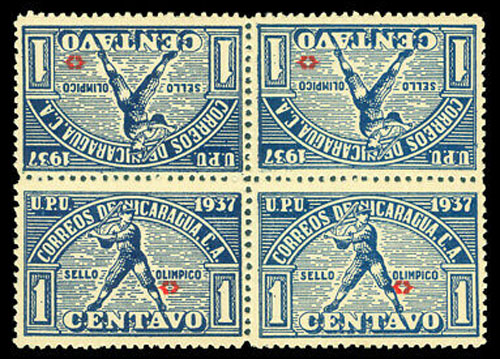
Issued by Nicaragua in May 1937, this stamp set was produced in advance of the IV Central American and Caribbean Games, which were held in Panama City in February 1938. The stamps are explicitly labeled Sello Olímpico and were intended as a commemorative issue tied to the upcoming regional multi-sport competition rather than to a specific venue or event within the Games themselves.
The issue consists of four stamps, all depicting the same image of a baseball batter in mid-swing, printed in four different colors: blue, green, red, and orange. At the Games in baseball, Cuba won the gold medal, Panama finishing second, and Nicaragua earned the bronze, making the baseball theme directly relevant to Nicaragua’s participation in the event.
1938 Panama – Central American and Caribbean Games
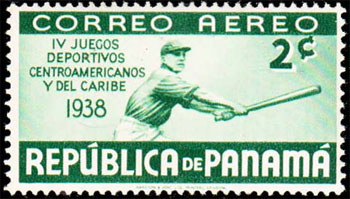
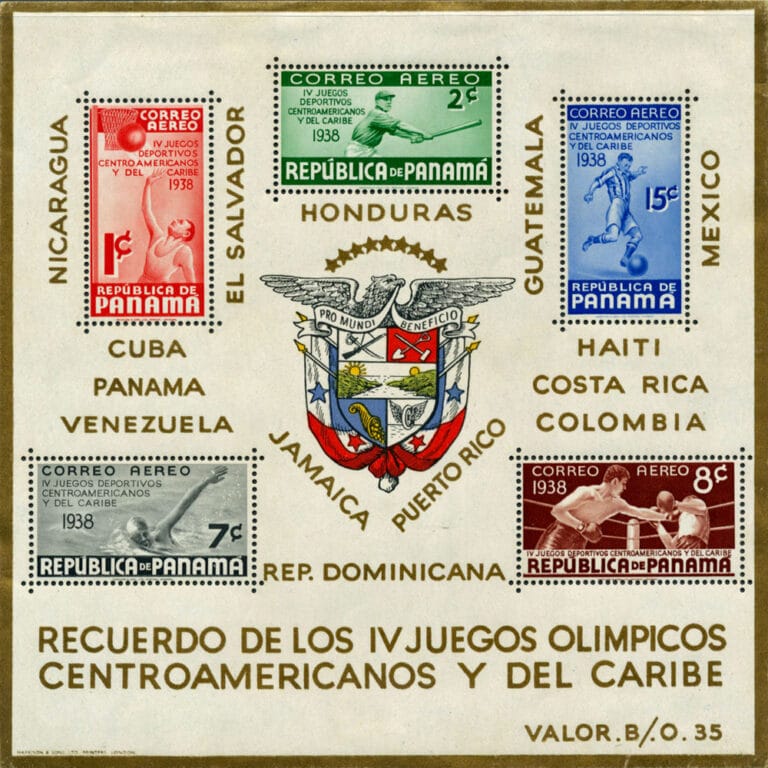
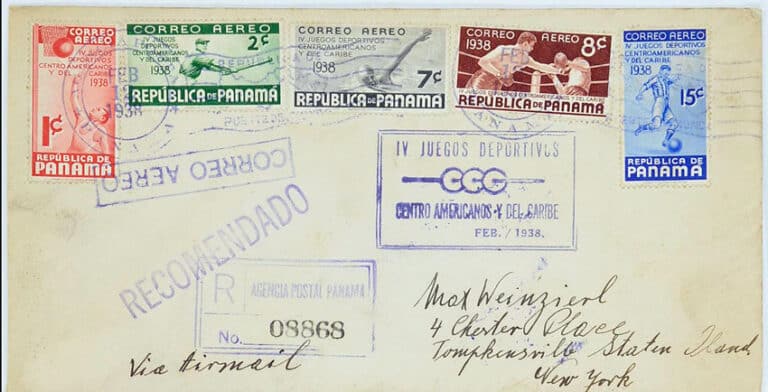
The fourth Central American and Caribbean Games were held in 1938 in Panama City, marking the first time Panama hosted the regional multi-sport competition. Known officially as the IV Juegos Deportivos Centroamericanos y del Caribe, the Games brought together athletes from across Central America, the Caribbean, and neighboring nations, reflecting the growing role of organized international sport in the region during the interwar period.
To commemorate the event, Panama issued a set of five airmail stamps, each depicting a different sport contested at the Games: baseball, basketball, boxing, soccer, and swimming. Each sport carries a distinct denomination, with the baseball stamp valued at 2 centésimos. At the center of the sheet is Panama’s national coat of arms, featuring the shield, crossed tools, rising sun, and eagle with the national motto “Pro Mundi Beneficio” (For the Benefit of the World), underscoring Panama’s identity as an international crossroads and host nation for the Games.
1944 Venezuela – Venezuelan Amateur Baseball World Series
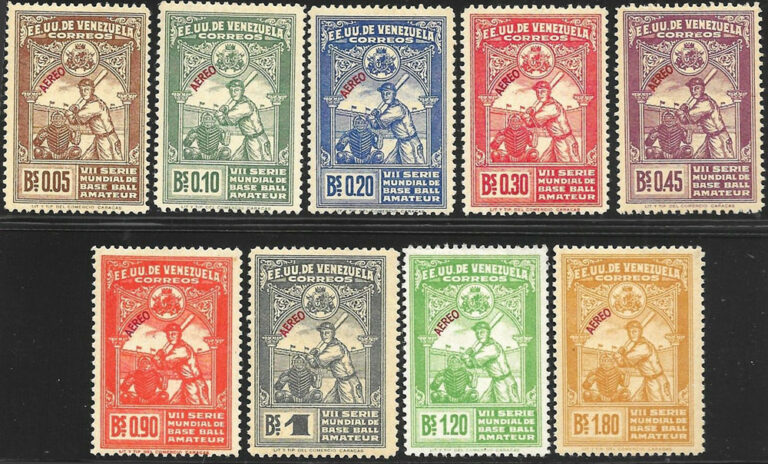
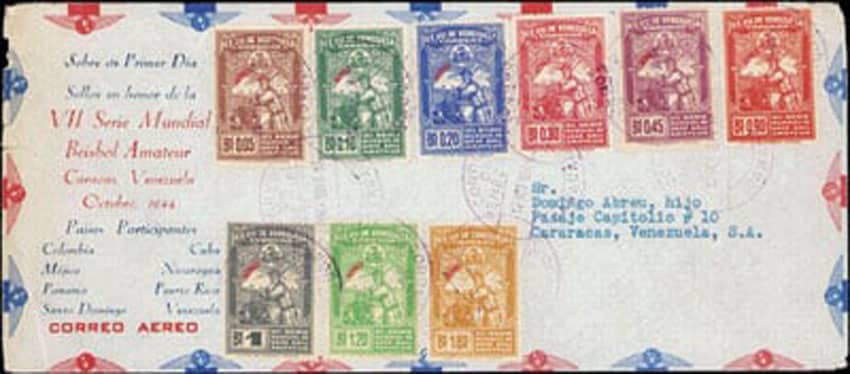
These stamps were issued by Venezuela in 1944 to commemorate the 7th Amateur Baseball World Series, or Serie Mundial de Base Ball Amateur, an international tournament for national amateur teams and a forerunner to today’s Baseball World Cup. The event was held in Caracas, marking the first time the Amateur World Series was staged outside Cuba, and it highlighted Venezuela’s growing prominence in international baseball during the mid-20th century.
The complete airmail set consists of nine stamps, all sharing the same central design of a batter at the plate with a catcher behind him, symbolizing the game itself rather than any specific team or player. Each stamp was printed in a different color and denomination, including black, blue, brown, gold/yellow, light green, dark green, orange, purple, and red. The stamps were issued specifically for airmail service and were produced in a limited quantity of approximately 10,000 complete sets.
1948 Japan – 3rd National Athletic Meet Between Yawata & Fukuoka
Issued on October 29, 1948, this Japanese commemorative stamp series marks the 3rd National Athletic Meet (Dai-san-kai Kokumin Taiiku Taikai), held in Fukuoka Prefecture on the island of Kyushu. The meet was organized as a nationwide amateur competition in which athletes represented their home prefectures, Japan’s primary administrative divisions comparable to U.S. states.
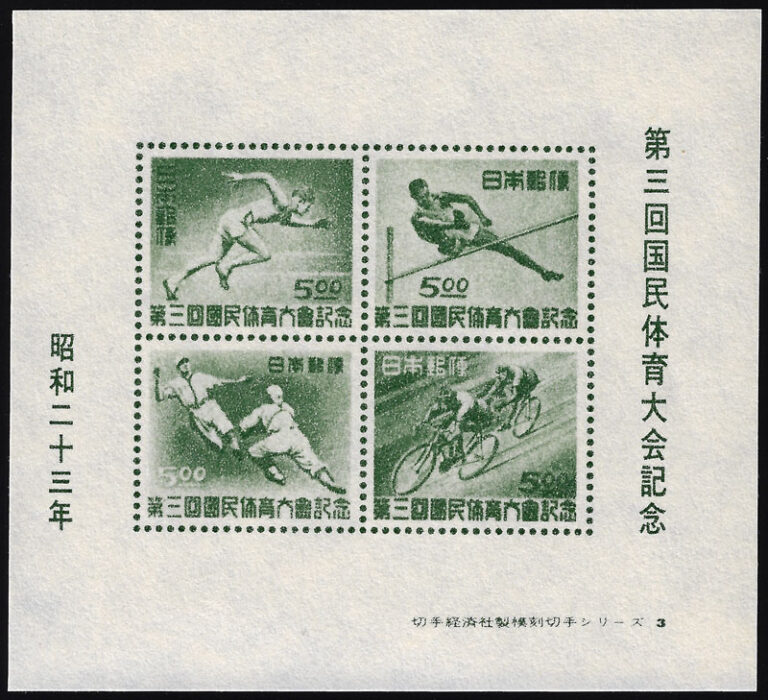
The issue consists of four sports stamps, each denominated 5¥ (Japanese yen), depicting baseball, track, high jump, and cycling. Approximately two million of each stamp were printed.
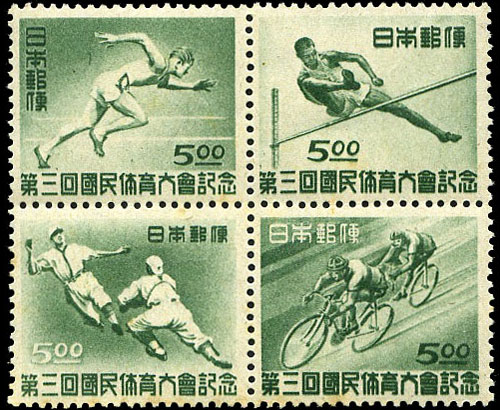
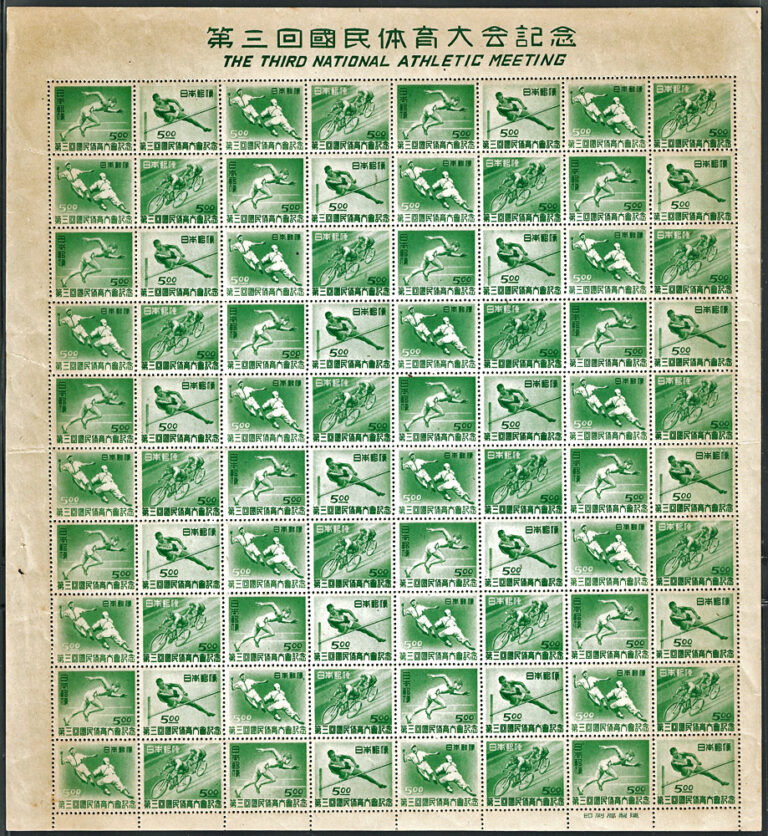
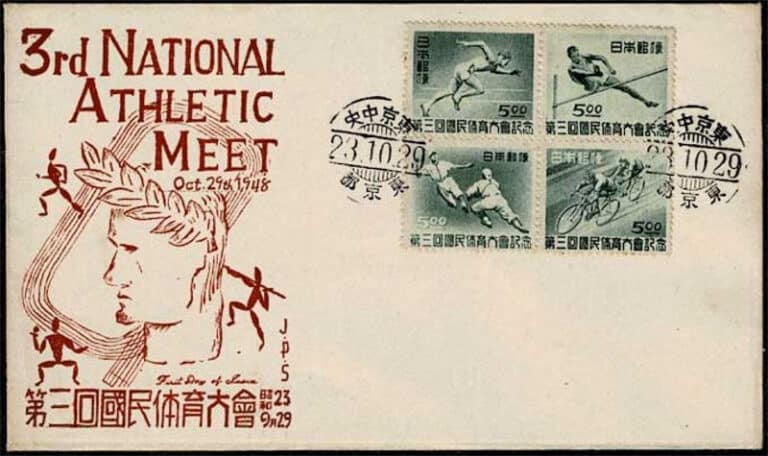
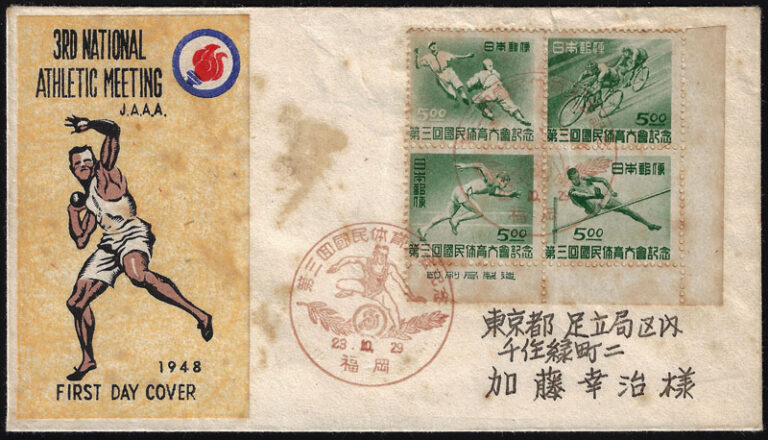
This imitation stamp sheet was produced by Keizaisha (also rendered Kyokeisha), a Japanese publisher known for postwar philatelic reproductions. The sheet reproduces the 1948 3rd National Athletic Meet stamps using printed dot perforations rather than actual perforations and was issued without adhesive backing. The sheet was hand-cut, resulting in uneven outer margins, a common characteristic of Keizaisha imitation issues.
Text printed along the bottom identifies the item as an imitation stamp series produced by Keizaisha, making clear that it was not intended for postal use or to be mistaken for an official issue. The manufacturer’s name appears in varying Romanized forms due to differences in Japanese-to-English transliteration. These sheets are recognized as non-postal reproductions produced for reference, display, or collecting purposes rather than as counterfeit postage.
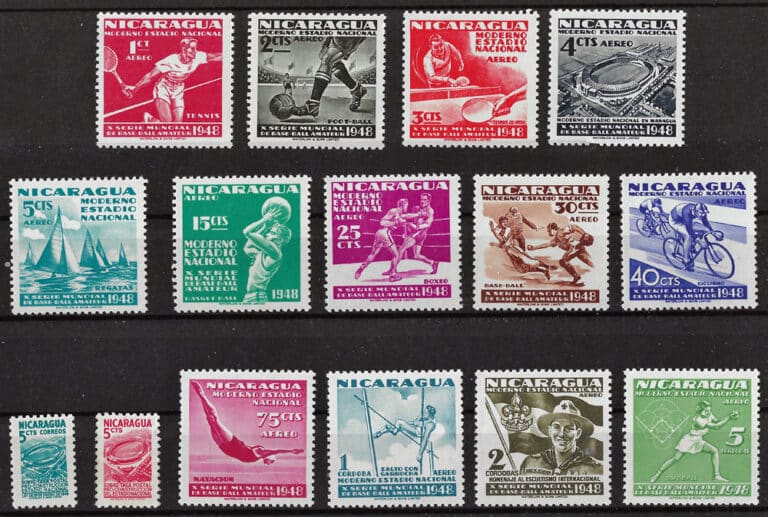
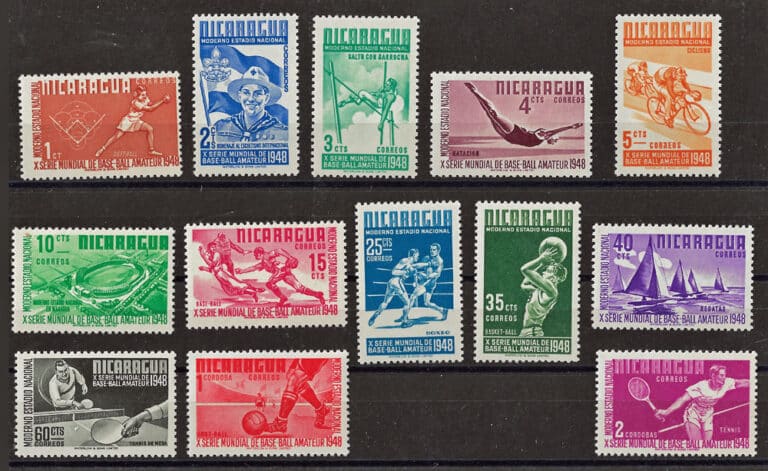
1949 Nicaragua – 10th World Series of Amateur Baseball
Issued beginning on July 15, 1949, this large Nicaraguan stamp issue commemorates two closely linked national initiatives: the 10th Amateur Baseball World Series (Décima Serie Mundial de Base-Ball Amateur), held in Managua from November 20 to December 12, 1948, and the construction of the Moderno Estadio Nacional, Nicaragua’s new national stadium. The stamps were authorized as a joint commemoration of the international tournament and the stadium project, which explains the unusually broad scope of subjects included in the issue.
Although the Amateur World Series was the central event being honored, the designs extend beyond baseball to reflect a wider national sports program. Approved subjects include baseball, basketball, boxing, cycling, swimming, football (soccer), tennis, table tennis, sailing (regattas), pole vault, softball, scouting, and views of the National Stadium. The Dominican Republic won the 1948 tournament with an 8–1 record, capturing the nation’s only Amateur World Series title. Pitcher Ramón del Monte was named Most Valuable Player after finishing 4–0 with a 0.34 ERA, while Manuel Cáceres, B. Arias, and Elías Farías led major offensive categories.
Sports in the series were issued in multiple denominations and formats. Air stamps were issued in square format, while ordinary postage stamps were issued in rectangular format. Baseball was issued as a 30¢ air stamp (200,000 printed) and a 15¢ ordinary stamp (200,000 printed). Softball was issued as a 5 córdobas air stamp (40,000 printed) and a 1¢ ordinary stamp (3,000,000 printed). Only 2,500 of each airmail souvenir sheet were issued, while 10,000 of each ordinary souvenir sheet were produced. See the complete 1949 Nicaragua collection.
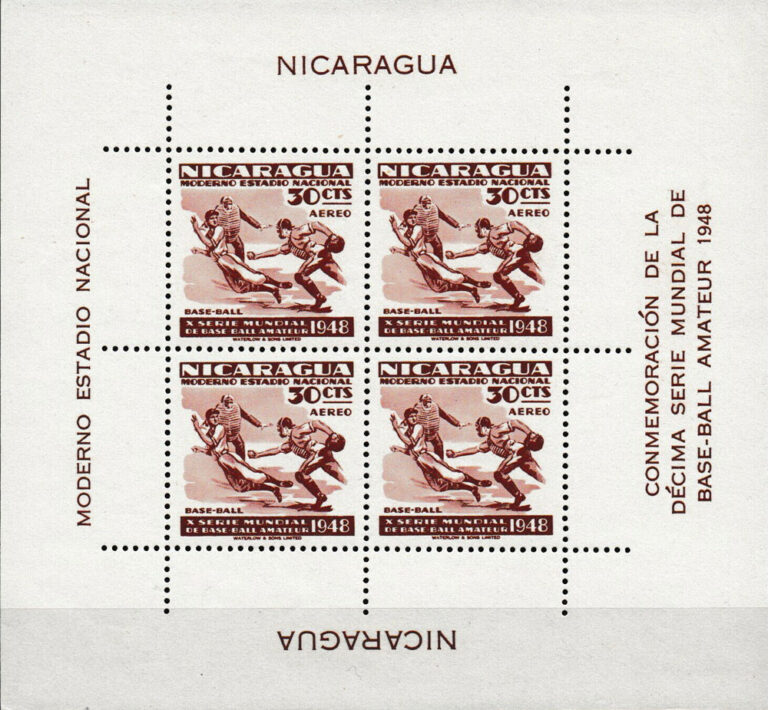
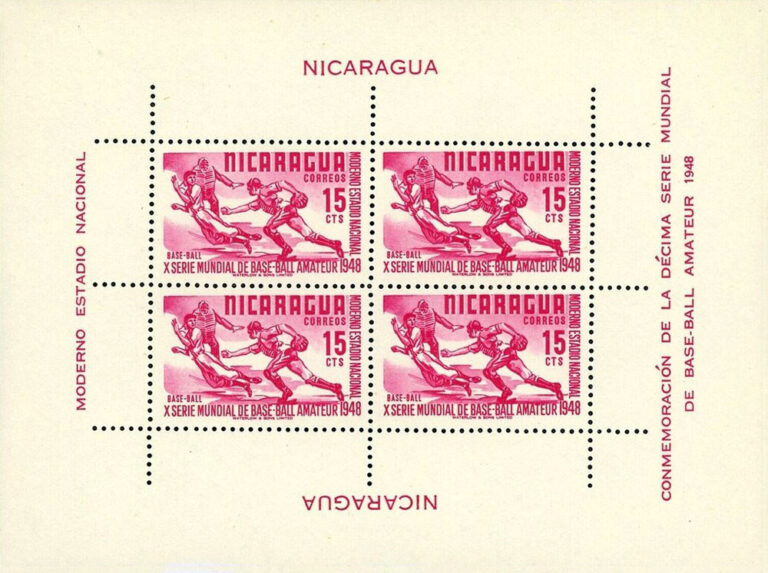
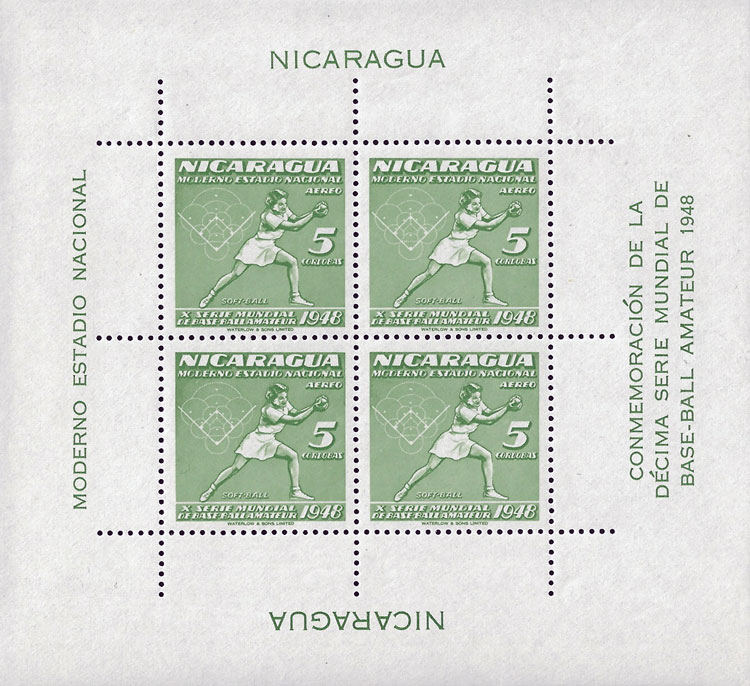
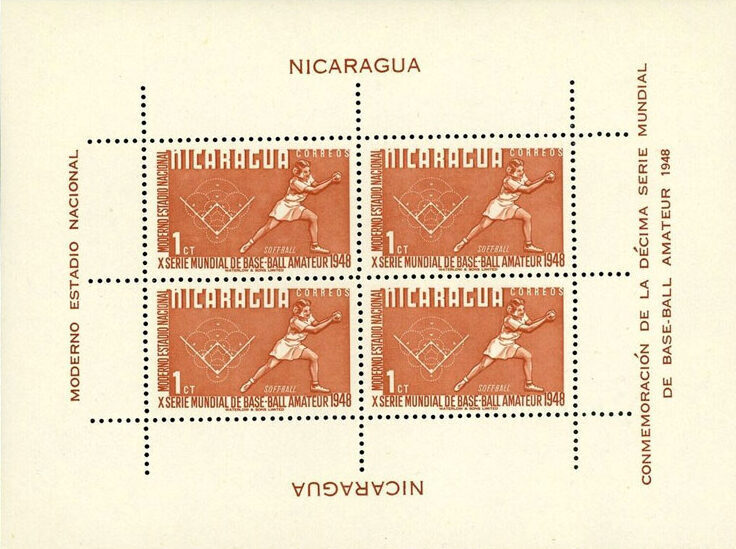
All 26 stamps in the main edition carry the inscription “X Serie Mundial de Base-Ball Amateur 1948.” Because this wording appears on every stamp, all designs in the set, including those depicting non-baseball sports and stadium imagery, are formally classified as part of the Amateur Baseball World Series issue.
The set is evenly divided by subject and format, with 13 subjects, each issued in both ordinary mail (rectangular) and airmail (square) stamp formats, resulting in a total of 26 stamps.
1951 Argentina – Pan American Games
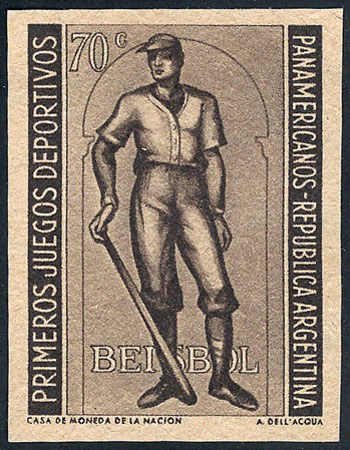
Released on February 25, 1951, this stamp relates to the First Pan American Games held in Buenos Aires, Argentina. The baseball design shown here is an unadopted essay, created as a preliminary proposal but never officially issued for postal use. Printed by the Casa de Moneda de la Nación, Argentina’s national mint, and designed by Amadeo Dell’Acqua, the stamp depicts a baseball player and carries a denomination of 70 centavos (70c). It was produced on opaque paper, and surviving examples are considered extremely rare.
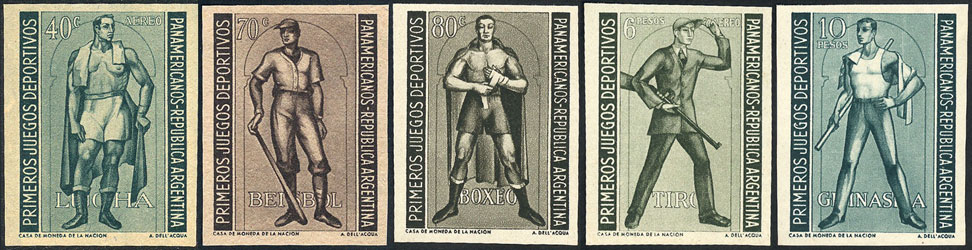
Other proposed designs associated with this Pan American Games stamp series depict Wrestling (40 Centavos Aéreo), Boxing (80 Centavos), Shooting (6 Pesos Aéreo), and Gymnastics (10 Pesos). Like the baseball design, these stamps are generally understood to exist as essays or proofs rather than officially issued postage, reflecting the broader planning stage of Argentina’s philatelic program for the inaugural Pan American Games.
1955 Liberia – Sports
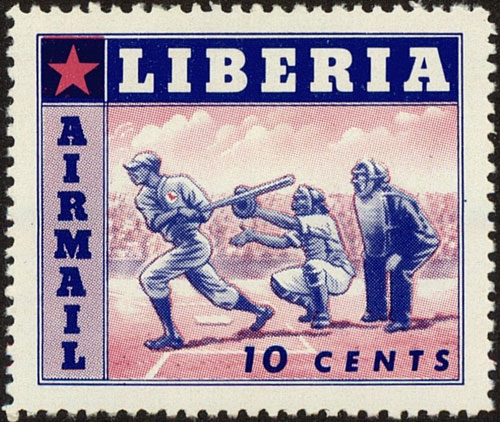
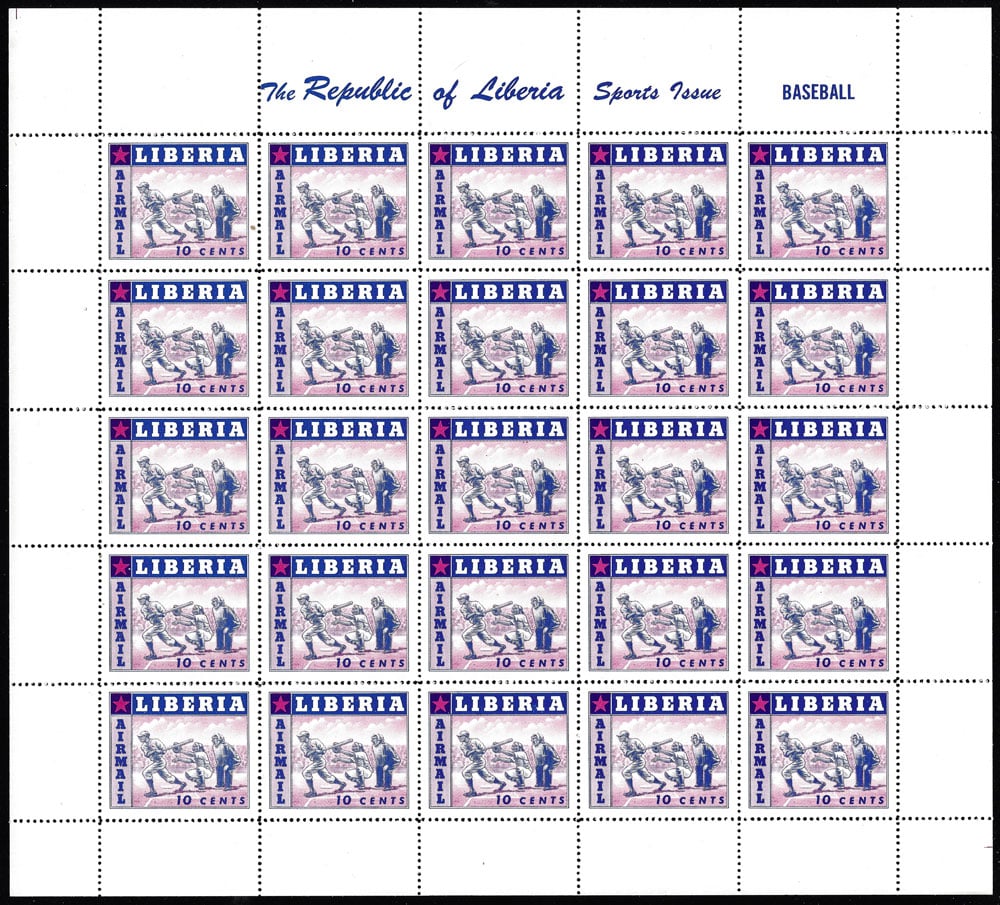
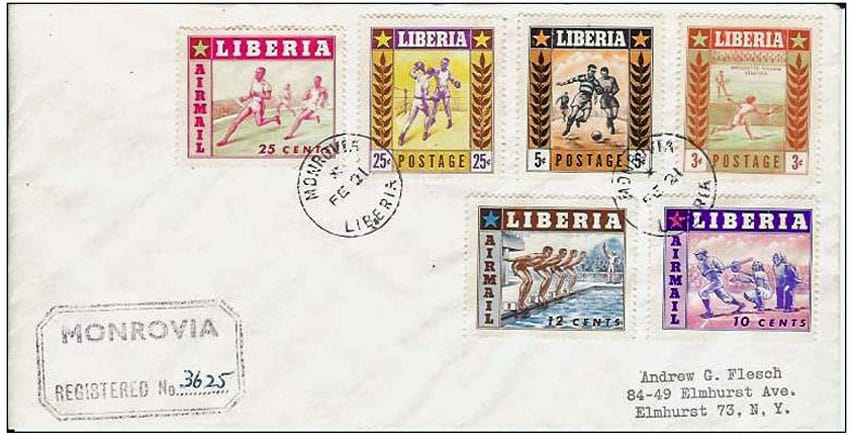
Issued on January 26, 1955, Liberia’s Sports series consists of six stamps depicting different athletic disciplines. Tennis, soccer, and boxing were issued as regular postage stamps, while baseball, swimming, and track were designated for airmail use.
The baseball stamp, shown here, is the 10-cent airmail issue and features a traditional game-action scene with a batter at the plate, a catcher, and an umpire. While baseball was not a widespread organized sport within Liberia at the time, its inclusion aligns with the country’s frequent use of internationally recognized sports imagery in commemorative and thematic stamp issues during this period.
1956 Taiwan – Year of the Child
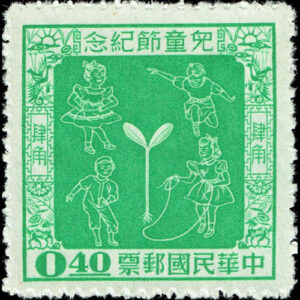
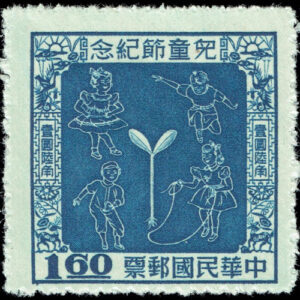
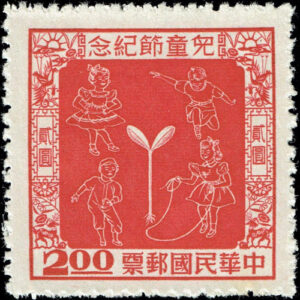
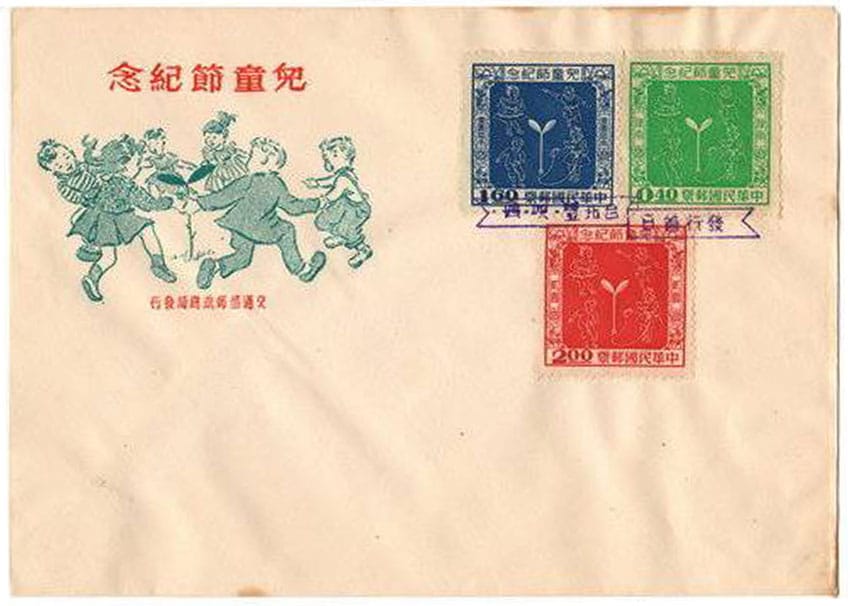
Issued on April 4, 1956, this stamp set was released by the Republic of China (Taiwan) to commemorate Children’s Day, an observance dedicated to child welfare, education, and healthy development. Children’s Day had been formally recognized in China earlier in the 20th century and continued to be observed in Taiwan after 1949 as part of broader public campaigns emphasizing youth, family, and social stability. The 1956 issue consists of three stamps, printed in green, blue, and red, with denominations of 40¢, $1.60, and $2.00.
Each stamp features the same central design showing four children engaged in play, positioned one in each corner around a sprouting plant symbolizing growth and nurturing. The activities depicted include a ballerina (top left), a soccer player (top right), a baseball fielder (bottom left), and a child jumping rope (bottom right). These scenes reflect a balance of physical activity, sport, and childhood recreation rather than organized competition. Baseball’s inclusion aligns with its established presence in Taiwan while the overall imagery reinforces themes of health, play, and childhood development central to Children’s Day observances.
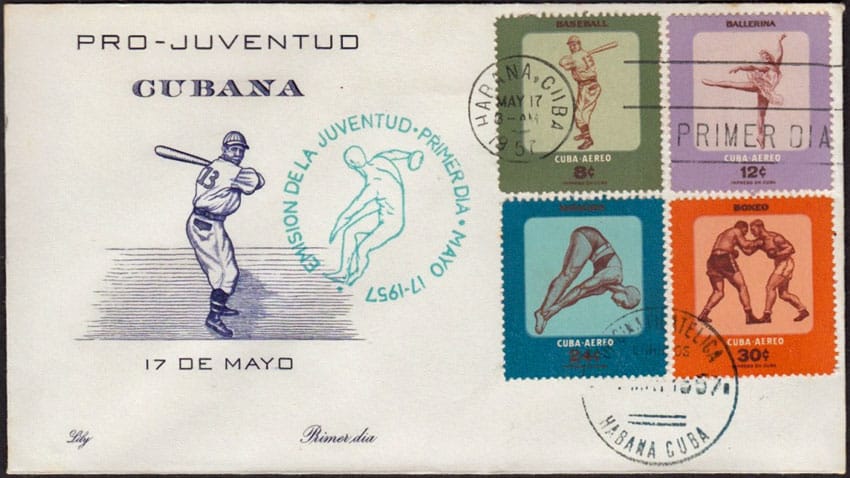
1957 Cuba – Youth Recreation
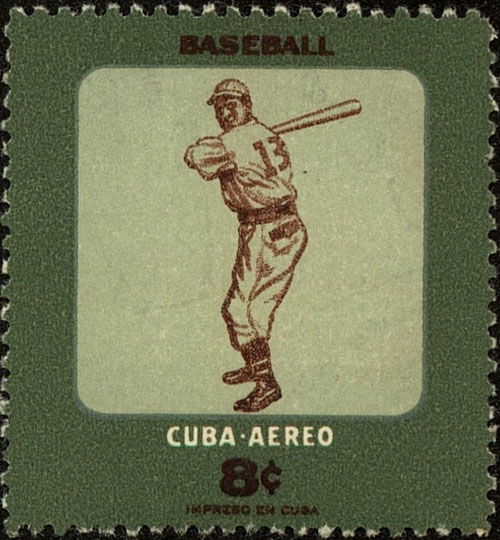
Issued on May 17, 1957, Cuba’s Youth Recreation series, also known as Pro-Juventud Cubana or Young Athletes, consists of four airmail stamps depicting youth athletic and recreational activities. The stamps feature baseball, ballet (ballerina), diving, and boxing, each printed in a different color. All four were issued as Cuba Aéreo stamps, with denominations ranging from 8¢ to 30¢.
The series reflects mid-1950s Cuban government programs promoting physical activity, sport, and youth development. Baseball’s inclusion aligns with its long-established cultural importance in Cuba, while the remaining designs emphasize a broader view of athletic and physical education during the pre-revolutionary period.
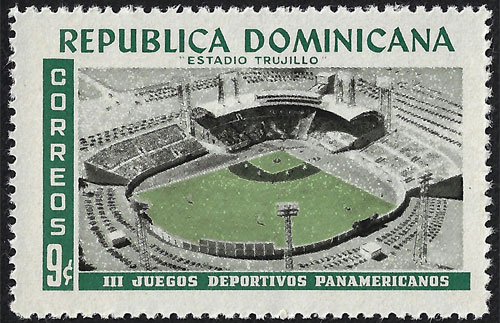
1959 Dominican Republic – 3rd Pan American Games
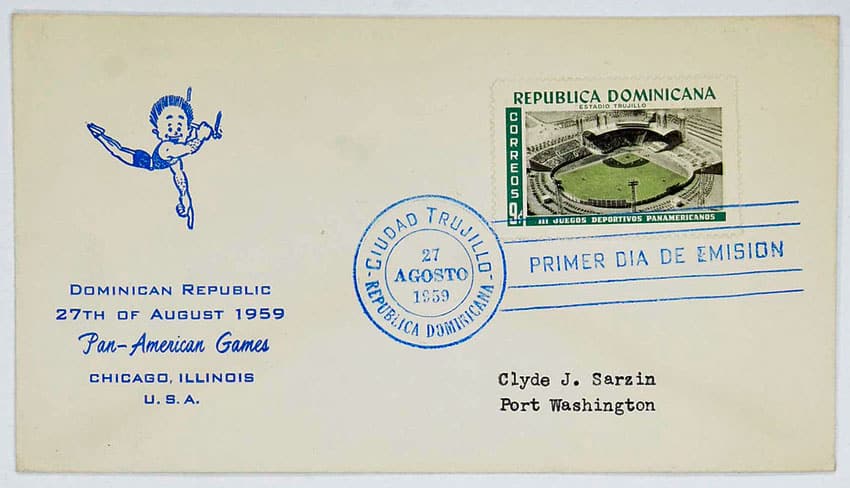
Issued on August 27, 1959, this stamp commemorates the Third Pan American Games and depicts Estadio Trujillo in Santo Domingo, completed in 1955 during the dictatorship of Rafael Leónidas Trujillo Molina. The stadium was a centerpiece of the regime’s emphasis on large-scale public works and international sporting visibility. Following the fall of the Trujillo government, the venue was renamed Estadio Quisqueya.
While the stamp honors the 1959 Pan American Games, baseball events were not held in the Dominican Republic. All baseball competitions took place in Chicago at Comiskey Park and Wrigley Field from August 27 to September 7, 1959. Venezuela won the tournament, and the Dominican Republic finished eighth. The stamp therefore commemorates national infrastructure tied to the Games rather than a local baseball venue.
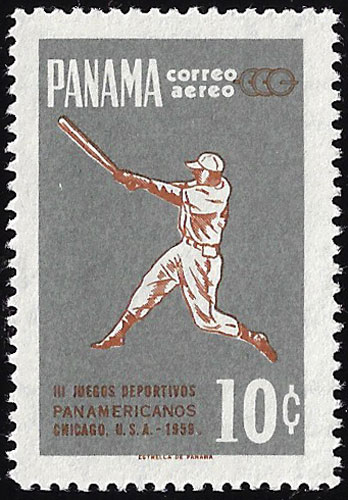
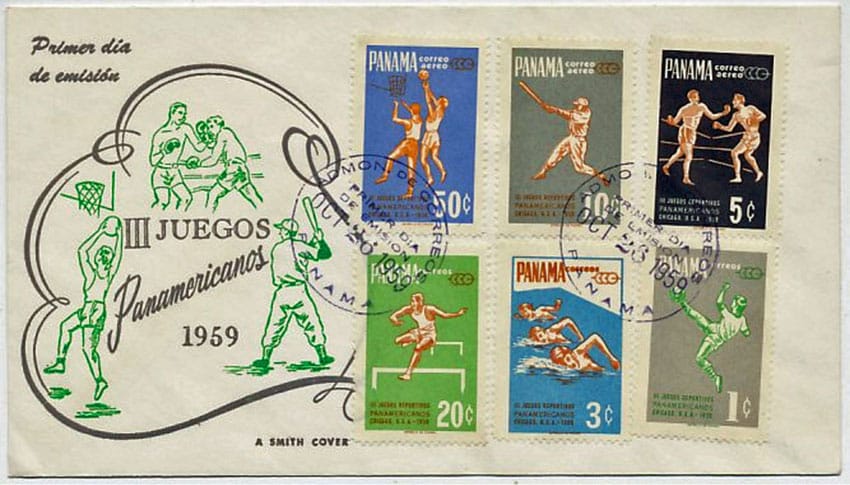
1959 Panama – 3rd Pan American Games
Issued on October 26, 1959, this Panamanian airmail stamp commemorates the Third Pan American Games held in Chicago, Illinois, from August 27 to September 7, 1959. Baseball was one of the featured sports, even though Panama did not compete in the baseball tournament itself. Baseball events during the 1959 Pan American Games were played at Comiskey Park and Wrigley Field, with Venezuela winning the gold medal after finishing 6–1.
See all Baseball U.S. Postage Stamps:
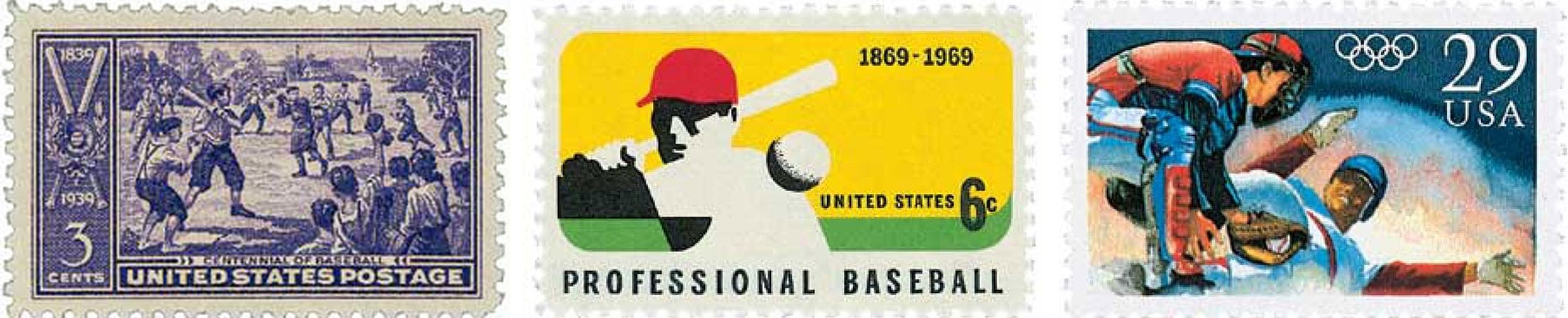
Baseball Postage Stamps
- U.S. Baseball Stamp Issues:
- 1939 Centennial of Baseball
- 1969 100th Anniversary of Baseball
- 1969 Grandma Moses
- 1982 Jackie Robinson
- 1983 Babe Ruth
- 1984 Roberto Clemente
- 1989 Lou Gehrig
- 1989 Legends Stamp Album
- 1991 Abbott & Costello
- 1992 Olympic Summer Games
- 1995 Recreational Sports
- 1996 Centennial Olympic Games
- 1996 Folk Heroes
- 1998-2000 Celebrate the Century
- 2000 Legends of Baseball
- 2000 Youth Team Sports
- 2001 Legendary Playing Fields
- 2006 Baseball Sluggers
- 2008 Take Me Out To The Ballgame
- 2010 Negro League Baseball
- 2012 MLB All-Stars
- 2012 Play Ball! Stamp Book
- 2017 Have a Ball
- 2020 Bugs Bunny
- 2021 Yogi Berra
- 2021 Backyard Games
- 2024 Hank Aaron
- 2026 American Icons
- MLB Pro Stamps
- Topps Stamp Collection Cards
- Non-Postage Stamps
- International Baseball Stamps:
- Int'l Stamps (1930 to 1959)
- Int'l Stamps (1960 to 1969)
- Int'l Stamps (1970 to 1979)
- Int'l Stamps (1980 to 1984)
- Int'l Stamps (1985 to 1989)
- Int'l Stamps (1990 to 1994)
- Int'l Stamps (1995 to 1999)
- Int'l Stamps (2000)
- Int'l Stamps (2001)
- Int'l Stamps (2002)
- Int'l Stamps (2003)
- Int'l Stamps (2004)
- Int'l Stamps (2005)
- Int'l Stamps (2006)
- Int'l Stamps (2007)
- Int'l Stamps (2008)
- Int'l Stamps (2009)
- Int'l Stamps (2010)
- Int'l Stamps (2011)
- Int'l Stamps (2012)
- Int'l Stamps (2013)
- Int'l Stamps (2014)
- Int'l Stamps (2015)
- Int'l Stamps (2016)
- Int'l Stamps (2017)
- Int'l Stamps (2018)
- Int'l Stamps (2019)
- Int'l Stamps (2020)
- Int'l Stamps (2021)
- Int'l Stamps (2022)
- Int'l Stamps (2023)
- Int'l Stamps (2024)
- Int'l Stamps (2025)
- Int'l Stamps (2026)
Browse the Complete Baseball Stamp Checklist, view U.S. Postage Stamps, or view a year from the international stamp collection.